 Merken
 I first tasted mango sticky rice on a sweltering Bangkok afternoon, sitting under a paper-thin awning while my friend's mother unwrapped it from banana leaves. The rice was still warm, the mango so perfectly ripe it seemed to melt before I could bite down, and I remember thinking: how is something this simple so impossibly good? Years later, I finally asked for her secrets, and what struck me wasn't any magic ingredient—it was her patience with the rice and her refusal to rush the coconut sauce. Now when I make it, I always have a quiet moment of gratitude for that sweltering day and the generosity that came with it.
I made this for a dinner party once and served it family-style on a single platter, letting everyone reach in and scoop warm rice onto their own plates before topping with mango. Watching faces light up—that moment between the first bite and the pause before they smile—I realized this dish carries hospitality in every spoonful. It became the dessert I reach for whenever I want to feel like I've done something genuinely thoughtful.
Ingredients
- Sticky rice (glutinous sweet rice), 1 cup: This is the soul of the dish; regular rice won't give you that luxurious, clingy texture that holds the coconut sauce like a secret.
- Water, for soaking and cooking: Soaking overnight isn't laziness—it's the difference between rice that's tender and rice that's creamy, so give it the time it deserves.
- Full-fat coconut milk, 1 cup: Don't reach for the light version; fat carries flavor, and this dessert needs that richness to sing.
- Granulated sugar, 1/4 cup: This sweetens the sauce without competing with the mango's natural honey-like notes.
- Salt, 1/4 tsp: A pinch of salt makes the coconut and sugar feel less one-note and more alive on your tongue.
- Ripe mangoes, 2 large: Choose ones that yield gently to pressure and smell sweet at the stem; if they smell like nothing, they'll taste like nothing.
- Coconut cream and toasted sesame seeds or mung beans, for garnish: These are optional but they add richness and a subtle nuttiness that lingers pleasantly.
Tired of Takeout? 🥡
Get 10 meals you can make faster than delivery arrives. Seriously.
One email. No spam. Unsubscribe anytime.
Instructions
- Rinse and soak the rice:
- Run cold water over the sticky rice in a fine-mesh strainer, stirring gently with your fingers until the water runs almost clear—you're washing away the starch that would make the final texture gluey instead of creamy. Drop it into a bowl of fresh water and leave it overnight, or for at least four hours if you're in a hurry.
- Steam the rice gently:
- Line a steamer basket with cheesecloth, drain your soaked rice, and spread it in an even layer. Steam for twenty-five to thirty minutes until the grains are tender and translucent at the edges but still hold their shape—they should feel slightly yielding when you press one between your teeth. If you don't have a steamer, a colander set over a pot of simmering water works just fine.
- Warm the coconut sauce:
- While the rice steams, pour coconut milk into a small saucepan and add sugar and salt, stirring over medium heat until the sugar dissolves completely. The moment you see tiny bubbles around the edges, pull it off the heat—boiling coconut milk tastes flat and slightly grainy instead of luxurious.
- Marry the rice and sauce:
- Transfer the hot rice to a mixing bowl and pour three-quarters of the warm coconut sauce over it, stirring very gently so you coat each grain without breaking them apart. Cover the bowl and let it sit for ten to fifteen minutes, letting the rice absorb the coconut like it's drinking something precious.
- Slice the mangoes:
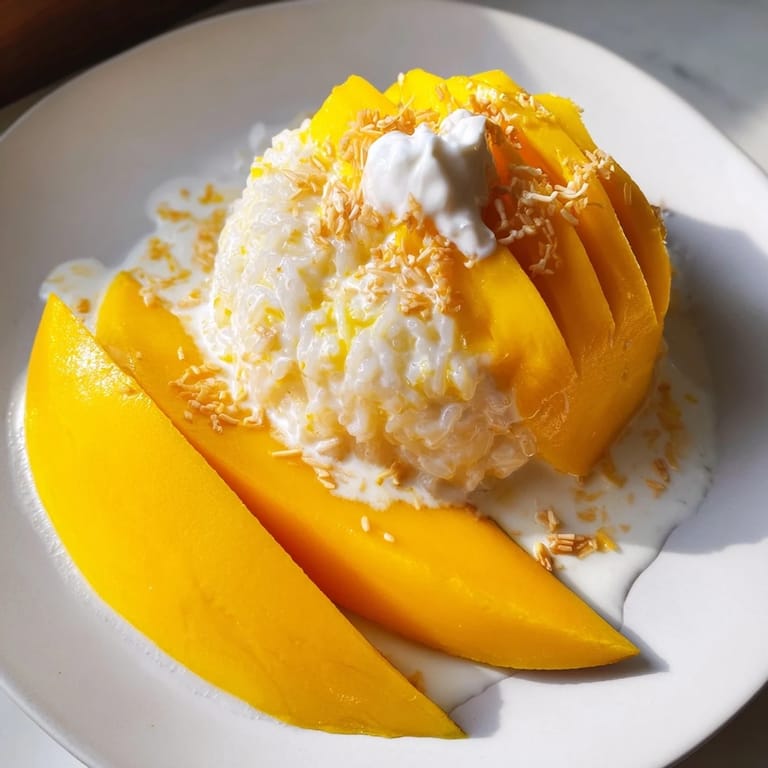
- Hold a ripe mango stem-side up and slice lengthwise just past the flat seed inside, then repeat on the other side. Score the flesh in a crosshatch pattern without cutting through the skin, then press the skin outward so the cubes pop up in a hedgehog shape—it's the most beautiful way to serve them and it makes eating effortless.
- Plate and serve:
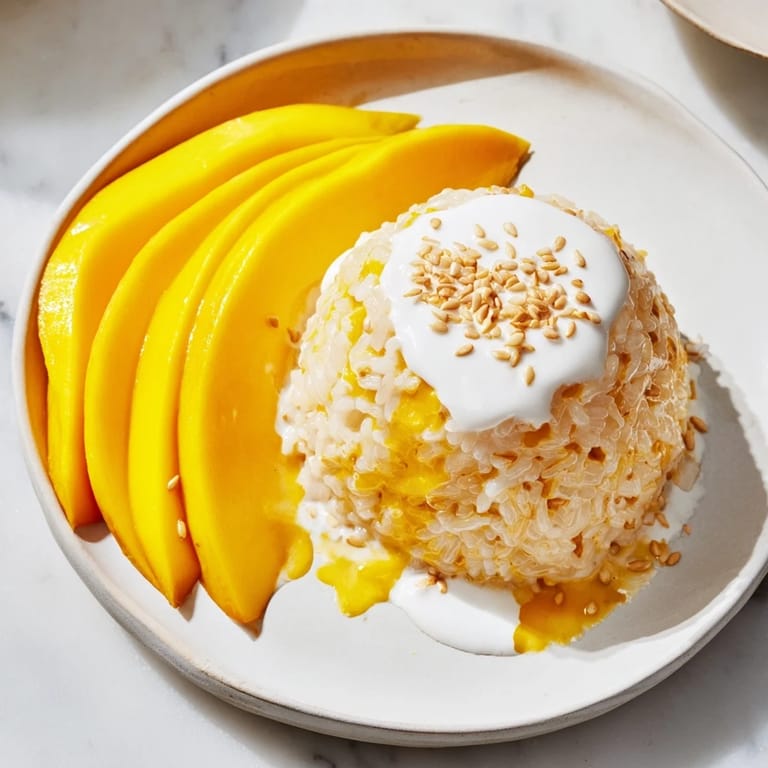
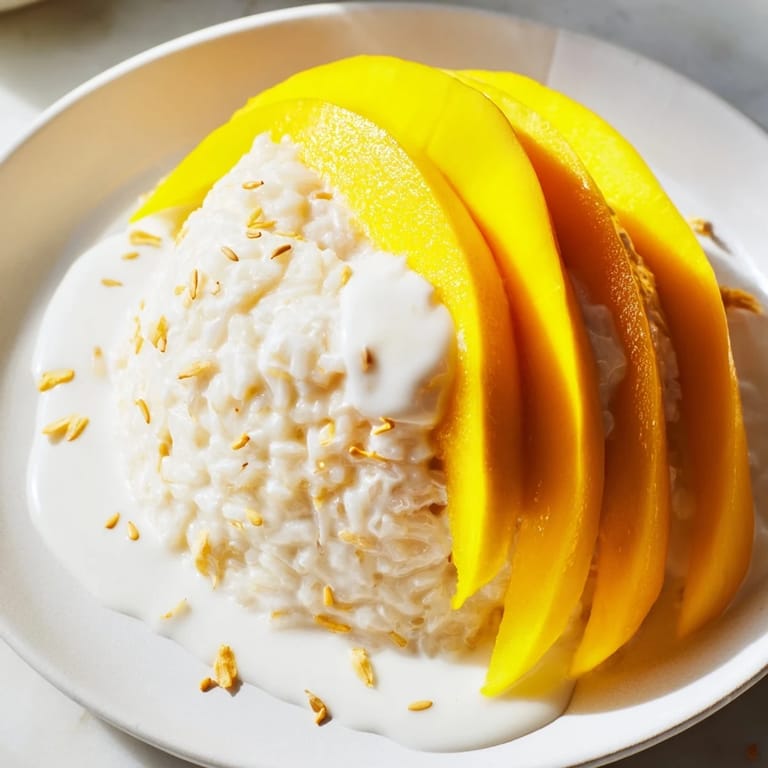
- Spoon a mound of sticky rice onto each plate, arrange mango slices beside it with that golden-yellow catching the light, then drizzle the remaining coconut sauce around the plate like you're drawing a line between two flavors. A small dollop of coconut cream on top and a scattered handful of toasted sesame seeds finish it with elegance.
 Merken
 There's a moment when the warm rice meets the cold, juicy sweetness of the mango, and that temperature contrast—that textural surprise—is what makes this dessert feel almost luxurious. It's simple food that tastes elegant, which might be the highest compliment any dish can receive.
The Secret to Perfect Mango Selection
The mango makes or breaks this dessert, so choose carefully. Look for mangoes that have a fragrant, slightly sweet smell when you hold them near your nose, especially at the stem end where they'll smell strongest. The skin should give slightly under gentle thumb pressure—not rock hard and not mushy—and the color should be a warm blend of gold and blush, never entirely green or wrinkled. If your market's mangoes feel unripe, buy them two or three days ahead and let them sit on the counter in a paper bag; they'll ripen without the mealy texture that happens when they ripen while hanging on the tree.
Why Soaking Really Matters
Sticky rice grains are wrapped in a starchy coating that keeps them firm and separate in the kernel. When you soak the rice, water begins to penetrate that coating, swelling the grain from the inside out so that when you steam it, every grain becomes tender and can absorb the coconut sauce evenly. Rush the soak and you'll end up with some grains that are chalky and others that are mushy—a texture disaster that no amount of sauce can fix. I learned this the hard way, of course, trying to make mango sticky rice with a ninety-minute soak because I forgot to start early. The rice was technically cooked, but it felt wrong on my tongue, and I've never cut corners since.
Variations and Flavor Riffs
Once you've mastered the classic, there are gentle variations that feel like natural extensions of this dessert. Some cooks add a vanilla bean or a few drops of coconut extract to the sauce for subtle perfume, while others stir a tablespoon of condensed milk into the warm coconut sauce for extra richness. If you find palm sugar at your market, substitute it one-to-one for the granulated sugar and you'll notice the sauce develops a deeper, almost caramel-like sweetness that feels more authentically Thai. Some Thai cooks press a few pandan leaves into the warm rice as it cools, which adds a delicate green-grass note that sounds odd until you taste how it brightens the entire plate.
- Palm sugar, condensed milk, and pandan leaves are all optional, but each one shifts the flavor profile in a way worth trying at least once.
- You can make this dessert with white or black sticky rice—the technique is identical, just the color and very subtle flavor changes.
- Serve it warm or at room temperature, never cold, and always eat it the same day you assemble it for the best texture.
 Merken
 This dessert teaches patience in the gentlest way, asking only that you soak rice overnight and pay attention as things warm and soften. Every time I make it, I think about that Bangkok afternoon and I'm grateful for a dish that tastes like generosity.
Fragen & Antworten zum Rezept
- → Wie wird Klebreis am besten zubereitet?
Klebreis sollte vor dem Dämpfen gründlich gespült und mindestens vier Stunden eingeweicht werden, um eine weiche, klebrige Konsistenz zu erzielen.
- → Kann man eine Alternative zu Zucker verwenden?
Ja, Palmzucker kann als Ersatz verwendet werden, um einen reicheren, karamellartigen Geschmack zu erzielen.
- → Weshalb sollte man den gedämpften Reis nicht im Kühlschrank lagern?
Beim Kühlen wird der Klebreis hart und verliert seine cremige Konsistenz, daher empfiehlt sich der Verzehr frisch nach der Zubereitung.
- → Welche Rolle spielt die Kokosmilch im Gericht?
Kokosmilch sorgt für eine cremige Textur und verleiht dem Klebreis eine dezente, süße Kokosnote, die perfekt mit der fruchtigen Mango harmoniert.
- → Kann ich das Gericht auch ohne Dämpfer zubereiten?
Alternativ kann Klebreis in einem Topf mit wenig Wasser sehr vorsichtig gegart werden, allerdings ist das Dämpfen optimal für die gewünschte Konsistenz.